Check out my building blog to learn more about construction for your home or office in Austin! David L. Traut, President, CAPS Certified (512)444-0097

The Forever Home Blueprint | Designing A Home That Grows With You

Posted byDavid L. Traut, CAPS on Tue, Sep 08, 2026 @ 10:09 AM

Introduction

Most people don't wake up one morning needing an accessible home. The need develops gradually through aging, an injury, surgery, or a changing health condition.

Unfortunately, many homeowners wait until a crisis forces them to remodel quickly. That often leads to rushed decisions, higher costs, and unnecessary stress.

At T-Square Company in Austin, Texas, we encourage homeowners to think differently. We introduce them to a Forever Home Blueprint. This long-term strategy helps your home adapt as your needs change, allowing you to remain independent, comfortable, and safe for decades.

There comes a moment in almost every homeowner's life when they look around their home and begin to wonder what the future might hold. It may happen after recovering from surgery, helping an aging parent, welcoming a new grandchild, or simply noticing that climbing the stairs isn't quite as easy as it used to be. Suddenly, the home that has served your family so well begins to reveal small obstacles that were once easy to overlook.

At T-Square Company, we've spent more than three decades helping homeowners throughout Central Texas adapt their homes to changing lifestyles and abilities. One lesson has remained constant throughout those years: the best time to prepare your home for the future is long before you actually need to.

That's what I call creating a Forever Home Blueprint using the principles of Universal Design.


Creating a Forever Home Blueprint for Aging in Place.

Why Every Home Needs A Forever Home Blueprint

A Forever Home Blueprint isn't a set of construction drawings or a remodeling contract. It's a long-term vision that allows your home to evolve as your life changes. Instead of waiting for an illness, injury, or health crisis to force expensive and hurried renovations, homeowners can make thoughtful improvements over time, creating a home that continues to provide comfort, safety, and independence for decades.

Think of your home as something that should mature alongside you. Just as we update our financial plans, insurance policies, and retirement goals throughout life, our homes deserve the same level of planning.

How To Build Your Forever Home Over Time

The journey often begins at the front door.

A single step that seems insignificant today could become one of tomorrow's greatest barriers. A no-step entrance allows everyone,  from parents pushing strollers to someone recovering from hip surgery,  to enter safely and comfortably. Wide walkways, better lighting, and slip-resistant surfaces create welcoming spaces while quietly reducing the risk of falls.

Once inside, thoughtful design becomes even more important. Hallways should allow people to move freely, doorways should accommodate walkers or wheelchairs if they ever become necessary, and lever-style door handles should replace traditional knobs that become difficult to operate for someone with arthritis or reduced hand strength. These aren't institutional features. They're examples of good design that simply make life easier for everyone.

The kitchen, often called the heart of the home, should also be designed for flexibility. Pull-out shelves eliminate the need to crawl into deep cabinets. Drawers provide easier access than lower cabinets. Varying countertop heights can accommodate people whether they're standing, seated, or using mobility equipment. Accessible kitchens aren't about sacrificing beauty—they're about making beautiful spaces work better throughout every stage of life.

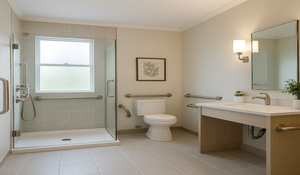
Bathrooms deserve special attention because they remain one of the most common locations for injuries inside the home. A curbless shower, strategically placed grab bars, non-slip flooring, comfort-height toilets, and improved lighting all contribute to a safer environment while maintaining an elegant appearance. Many homeowners are surprised to discover that today's accessible bathrooms often resemble luxury spa retreats more than traditional accessible spaces.

How Smart Home Technology is Transforming Aging in Place

Bedrooms are evolving as well. Increasingly, homeowners are creating flexible rooms that can serve multiple purposes over time. A guest room today may someday become a caregiver suite or a temporary recovery room after surgery. By planning for wider clearances, convenient electrical outlets, improved lighting, and accessible bathrooms nearby, families gain tremendous flexibility without dramatically changing the appearance of their homes.

Technology is becoming another essential part of the Forever Home Blueprint.

Today's smart homes do far more than turn lights on and off. Voice-controlled systems can adjust lighting, lock doors, operate window coverings, and call family members with simple spoken commands. Smart thermostats maintain comfort automatically, while security systems provide reassurance whether you're home or traveling.

Why The Home Is Becoming A Healthcare Hub

Artificial intelligence is beginning to take this even further. Instead of waiting for emergencies to happen, AI-powered systems can recognize subtle changes in daily routines that may indicate developing health concerns. A noticeable decrease in activity, interrupted sleep patterns, slower walking speeds, or changes in medication routines can all provide early warning signs that something may be changing. These technologies aren't designed to replace family caregivers—they're designed to support them by providing information that helps prevent problems before they become emergencies.

Healthcare itself is changing alongside our homes.

Telehealth appointments, remote patient monitoring, and home-based medical care are becoming increasingly common. More families are designing flexible treatment spaces that can accommodate physical therapy, visiting nurses, medical equipment, or virtual physician appointments without disrupting everyday life. The modern home is rapidly becoming an extension of the healthcare system, making thoughtful planning more valuable than ever before.

The Biggest Misconception About Aging in Place

Perhaps the greatest misconception about aging in place is that it only applies to older adults.

In reality, a Forever Home benefits every generation. It makes life easier for young families carrying infants, adults recovering from injuries, grandparents visiting for the holidays, and anyone who wants to live comfortably without unnecessary physical barriers. Universal Design isn't about planning for old age—it's about creating a home that serves people well throughout every stage of life.

A Forever Home Blueprint isn't completed all at once. It's built over the years through thoughtful decisions, carefully planned renovations, and investments that add value and prepare for the future. Some improvements are simple weekend projects. Others naturally become part of larger remodeling efforts. Together, they create a home that supports changing needs without sacrificing beauty, comfort, or personal style.

At T-Square Company, we believe every homeowner deserves more than a remodeling project. They deserve a plan. Our goal is to help families create homes that are prepared not only for today's needs but also for tomorrow's opportunities and challenges. When a home is designed to adapt, it becomes more than a place to live; it becomes a lifelong partner in health, independence, and peace of mind.

That's the true purpose of a Forever Home Blueprint. It's not about preparing for the unexpected. It's about designing a home that's ready for whatever life brings next.

How To Build Your Forever Home Over Time

A Forever Home isn't built in a weekend, and it doesn't require completing all modifications at once. The key is having a thoughtful plan that allows your home to evolve with your life. Some improvements are inexpensive and can be made immediately, while others are best incorporated into future remodeling projects.

At T-Square Company, we help homeowners create personalized blueprints that balance today's budget with tomorrow's needs. By combining Universal Design principles, accessibility expertise, and emerging technologies, we design homes that are safer, more comfortable, and prepared for whatever the future brings.

David L. Traut, CAPS, President of T-Square Company, has spent more than 30 years helping homeowners create safer, more accessible, and more valuable homes through Universal Design, aging-in-place remodeling, and innovative home technology. His Forever Home Blueprint approach helps families plan for today while preparing confidently for tomorrow. David is a founding member of the National Aging in Place Council and the award-winning author of Age in Place at Home: Adapting the Home Environment For All Generations, which is available on Amazon.


Tags: aging in place remodeling, aging in place, Universal Design,, home accessibility, accessible home design, home modifications, independent living, T-Square Company, smart home technology, telehealth, home safety, healthcare at home, forever home blueprint, at home monitoring

T-Square Company Is Helping Austin Homeowners Prepare for the Future

Posted byDavid L. Traut, CAPS on Tue, Sep 01, 2026 @ 15:09 PM


At T-Square Company, we believe successful aging in place requires more than installing accessibility features or other home modifications. It requires designing homes that are flexible enough to adapt as technology continues to evolve.

David L. Traut, CAPS, the president of T-Square Company, has spent more than 30 years helping Central Texas homeowners create homes that adapt to changing needs. Today, we're witnessing one of the most significant transformations our industry has ever experienced. The future of aging in place is no longer focused solely on physical modifications. It is about creating intelligent homes that combine thoughtful design and technology to help people remain independent longer and improve quality of life. 

Universal Design principles provide the foundation to build upon, while smart home technology, AI, telehealth, and connected healthcare systems add new layers of safety, convenience, and independence.

telehealth and aging in place work hand in hand together in smart homes

Smart Homes for Older Adults Are Becoming the New Standard

Today's smart homes for older adults do much more than control lights or adjust thermostats. Modern smart homes integrate dozens of connected technologies that work together to create a safer and healthier living environment.

Smart lighting automatically illuminates hallways and bathrooms at night, reducing fall risks. Voice-controlled assistants make it easier to control appliances, lock doors, call family members, or contact emergency services without reaching for a phone. Smart doorbells, cameras, and locks provide added security while allowing family members to monitor visitors from anywhere.

Environmental sensors can detect water leaks, smoke, carbon monoxide, or unusual temperature changes before they become serious problems. Together, these technologies create a home that continuously supports its occupants rather than simply sheltering them.

Whether you're planning a remodel, caring for aging parents, recovering from surgery, or building your forever home, investing in adaptable design today helps ensure your home is ready for tomorrow, and T-Square Company can help by leading the way.

The future of aging in place is already here. Homes are becoming intelligent, connected, and responsive environments that support healthier, safer, and more independent lives. By combining timeless design principles with emerging technology, homeowners can enjoy greater comfort, dignity, and peace of mind for years to come.

Aging in Place Innovations Are Expanding Every Year

The pace of aging in place innovations continues to accelerate.

Some of the newest technologies include:

  • Fall detection systems that recognize unusual movement without requiring wearable pendants.
  • Smart medication dispensers that remind users to take prescriptions and notify caregivers if doses are missed.
  • Robotic assistants capable of performing simple household tasks.
  • Smart refrigerators that monitor food inventory and expiration dates.
  • Voice-controlled appliances that reduce physical strain.
  • Autonomous vacuum cleaners and lawn equipment that reduce maintenance demands.
  • Indoor navigation lighting that adapts automatically to nighttime movement.

Many of these innovations were considered futuristic only a few years ago. Today, they are becoming increasingly affordable and practical for everyday homeowners.

Home-Based Healthcare Continues to Expand

The home is rapidly evolving into an extension of the healthcare system, fueling the demand for home-based healthcare  as America's population ages. 

Hospitals, physicians, insurers, and healthcare systems increasingly recognize that many treatments can be delivered safely inside the home. Virtual physician appointments, home infusion therapy, physical therapy, occupational therapy, nursing visits, and remote rehabilitation programs are becoming commonplace.

Patients recovering from surgery can often avoid lengthy hospital stays while receiving professional care in the comfort of familiar surroundings.

Healthcare providers increasingly use remote diagnostic equipment, telehealth consultations, virtual nursing support, and digital rehabilitation programs to serve patients wherever they live.

Many treatments once requiring hospitalization can now be delivered safely at home, reducing costs while improving patient comfort and satisfaction.

This trend is encouraging architects, builders, remodelers, and accessibility professionals to rethink how homes should be designed. Flexible treatment rooms, improved lighting, accessible bathrooms, wider hallways, reliable internet connectivity, backup power systems, and dedicated telehealth spaces are becoming valuable features in today's homes.

Remote Caregiver Monitoring Supports Families

Millions of adult children worry about aging parents who live alone.

Remote caregiver monitoring offers reassurance without constant supervision.

Authorized family members can receive notifications if medications are missed, unusual inactivity occurs, doors remain open unexpectedly, or an emergency arises.

Rather than feeling intrusive, these systems allow older adults to maintain independence while giving family members greater confidence that someone will be alerted if assistance becomes necessary.

The result is increased peace of mind for everyone involved.

Connected Health Ecosystems Bring Everything Together

The most exciting development may be the emergence of connected health ecosystems.

Instead of isolated devices operating independently, tomorrow's homes will integrate health monitoring, smart home technology, healthcare providers, caregivers, emergency responders, and family members into a seamless network.

Imagine a home where a smart bed detects poor sleep, wearable sensors react to increased heart rate, motion sensors identify slower walking speed, and AI analyzes all this information together. The system can recommend scheduling a telehealth appointment, notify family members if appropriate, or share relevant health trends with the physician—all while respecting the homeowner's privacy preferences.

This integrated approach allows homes to become active partners in maintaining health rather than simply serving as places to live.

T-Square Company Is Helping Homeowners Prepare for the Future

At T-Square Company, we know that technology supporting independent living promotes freedom, but technology cannot replace family relationships or compassionate caregivers. It can, however, eliminate many of the small daily challenges that gradually reduce independence.  The goal of technology for independent living is simple: help people maintain control over their lives for as long as possible.  When thoughtfully integrated into a universally designed home, technology becomes nearly invisible while quietly supporting everyday living.

Contact T-Square Company today to schedule a professional home assessment. Call us at 512-444-0097 and begin the journey towards designing and entering your forever home. David is the award-winning author of Age in Place at Home,  a complete guide for aging in place. His book is available on Amazon. 


Certified Aging In Place Specialist


Tags: CAPS, Universal Design,, accessible home design, T-Square Company, smart home technology, telehealth, predictive health monitoring, aging in place innovations, senior home modifications, smart homes for older adults, future of aging in place, AI powered home monitoring, healthcare at home, technology for independent living

Upcoming NAIPC Book Announcement | David L. Traut, CAPS

Posted byDavid L. Traut, CAPS on Tue, Jul 28, 2026 @ 14:07 PM

As a founding member, I'm honored to be a contributing author to the National Aging in Place Council's upcoming book, Housing Pillar, releasing in October 2026.

My chapter, "The Aging in Place Market Is Rapidly Changing Due to the Advances in High Tech," explores how AI, smart home technology, telehealth, predictive remote health monitoring, and connected home systems are transforming the future of independent living and Aging in Place technology.

NAIPC logo

As the award-winning author of "Age in Place at Home" and President of T-Square Company located in Austin, Texas, as well as a Certified Aging in Place Specialist (CAPS), I've spent more than 30 years helping homeowners create safer, healthier, and more accessible homes. During that time, I've watched aging in place evolve from simple home modifications like ramps and lever door handles to intelligent living environments where housing, healthcare, and technology work together to support independence and improve quality of life.

Whether you're a homeowner, caregiver, healthcare professional, builder, designer, or aging in place specialist, the homes we create today will shape how millions of Americans live tomorrow. This is the future of aging in place.

I'm excited to share more as we approach the October release of Housing Pillar and contribute to the conversation about the future of aging in place.

What This Means for Homeowners

The technologies for independent living discussed in this chapter are no longer ideas for the future leading the way to home-based healthcare, they are becoming practical tools that help people remain safely and independently in their own homes. Whether you're planning your forever home, caring for aging parents, remodeling for accessibility, or working as a housing or healthcare professional, understanding these emerging technologies will help you make informed decisions that improve safety, health, and quality of life involving smart homes for older adults healthcare at home. Please contact T-Square Company to find out more about aging in place. We can be reached at 512-444-0097.

#HousingPillar #AgingInPlace #UniversalDesign #SmartHomes #AI #Telehealth #Accessibility #HomeModifications #HealthcareInnovation #SeniorLiving #CAPS #NAIPC #TSquareCompany #Aging in Place Technology

Certified Aging In Place Specialist


Tags: aging in place, Universal Design,, home modifications, senior living, aging in place technology, smart home technology, telehealth, NAIPC, healthcare technology, accessibility, connected home, artificial intellegence, remote patient monitoring

The Overall Trend in Aging in Place

Posted byDavid L. Traut, CAPS on Tue, Jun 23, 2026 @ 13:06 PM

Universal Preference

The aging in place movement is rapidly becoming one of the most important shifts in housing, healthcare, and residential design in America. More adults than ever before want to remain in their own homes as they age rather than relocate to assisted living facilities or institutional care environments. People tend to equate institutional settings with reduced privacy, loss of independence, and social isolation.  Today's surveys consistently show that roughly 75-90% of older adults prefer to remain in their current homes as they age.  Furthermore, there is a massive shift toward prolonged independent living, driven by a desire for autonomy, a declining use of nursing homes, and a rapidly expanding "AgeTech" market.

At its core, the current trend, created by longevity, reflects a major cultural shift: people no longer see aging as something that should automatically require leaving home. Instead, homeowners increasingly view their homes as long-term assets that can be adapted to support safety, independence, wellness, and dignity at every stage of life. Hence, as baby boomers reach retirement age, the healthcare and home design industries are heavily adapting to support seniors living safely at home. 

An accessible bathroom created for aging in place

"AgeTech" and Smart Homes

The so-called novelty phase of health tech has matured into structural infrastructure. Homes are being retrofitted with AI assistants, wearable health monitors, automated medication dispensers, and proactive fall-detection sensors.

Telehealth Expansion

Virtual doctor visits and remote diagnostic tools provide real-time patient data, allowing physicians to monitor chronic conditions without requiring frequent in-office visits.

The healthcare industry is increasingly supporting home-based care models and flexible, customized treatment rooms that incorporate universal design principles.

Hospitals, insurers, and healthcare providers now recognize that safe home environments can encourage independence, support mental health, lower long-term health costs, and improve recovery outcomes.

As a result, aging in place is becoming increasingly connected to occupational therapy, home health services, preventive care, and wellness-focused residential design. The best homes of the future will not simply be adapted for living;  the future home is progressing into a complete care ecosystem.

Home Modifications  

Renovations involving widening doorways, adding grab bars, installing walk-in showers, and building first-floor bedrooms have become a major focus for remodeling and construction design. All home modifications are still very important for long-term accessibility.

Solo Agers and Community

Due to shifting family dynamics and smaller support ratios, trends are leaning toward multigenerational living, caregiver additions,  accessible additions, flexible guest suites, co-housing, and village networks that provide safety, sustainability,  community support, and helpful caretaking among various generations. 

Many families are redesigning homes to support aging parents while preserving privacy and independence for everyone involved.

In places like Austin and throughout Texas, interest in accessible ADUs (accessory dwelling units) and flexible housing solutions continues to grow as families seek alternatives to institutional care.

The Challenges

Despite the overwhelming desire to stay home, the US housing stock is largely unprepared, with an estimated 90% of homes lacking the necessary modifications for safe, long-term independent living. Additionally, there is an alarming shortage of professional caregivers, forcing families to rely more heavily on smart monitoring and automated systems to fill the gaps.

Emotional Wellness as a Central Focus

Perhaps the most important trend is that aging in place is no longer viewed only as a construction issue—it is now recognized as a quality-of-life issue. 

The conversation has evolved beyond simply “staying home longer.” The focus is increasingly about creating a forever home that supports healthy, meaningful living across generations.

Professionals like David L. Traut, a CAPS-certified practitioner, is the owner of T-Square Company located in Austin, Texas, and often emphasizes that aging in place succeeds best when homeowners begin planning early, think long-term, and create adaptable environments that evolve with changing needs, rather than waiting for a crisis to force change. David is an active founding member of the National Aging in Place Council.

David is also certified in Universal Design in both the United States and Australia. Drawing on decades of expertise, he published Age in Place at Home: Adapting the Home Environment for All Generations, a comprehensive guide that explores the role of Universal Design in creating safe, accessible homes.

📘 Age in Place at Home acts as a guide, taking readers room by room, explaining practical modifications that enhance safety, accessibility, and independence. The book is available on Amazon.

Home Accessibility Help


Tags: aging in place home modifications, aging in place, Universal Design,, aging in place design,, home accessibility, forever home, independent living, senior home safety, CAPS specialist, smart home technology, multigenerational living, aging in place trends, accessible remodeling, senior-friendly design, accessibility solutions

Telehealth and Aging in Place: How Technology Is Redefining Homes

Posted byDavid L. Traut, CAPS on Fri, Jun 12, 2026 @ 12:06 PM

The Shift—Healthcare Is Moving Into the Home 

For decades, aging in place focused on accessibility and physical safety, like installing grab bars, wider doorways, and zero-step entries. While these elements remain essential today, a new force is reshaping the industry: telehealth. Due to the technological advancement in remote monitoring, wearables, smart-home systems, and artificial intelligence, the home is becoming part of the care ecosystem itself. The best homes of the future will not simply be adapted for aging. They will be designed to respond to it.

Healthcare is no longer confined to hospitals, doctors' offices,  and clinics. Today, it’s happening in living rooms, bedrooms, kitchens, and especially in customized, flexible treatment rooms inside the home, through virtual visits and remote monitoring.

This shift is redefining what it means to create a safe and functional home that provides independence.

At T-Square Company, in Austin, Texas, we now view the home as more than a residence—it’s a care environment.


 telehealth is rapidly changing the aging in place market


Why Telehealth Is a Game-Changer for Aging in Place

Telehealth is removing one of the biggest barriers older adults face: access to care.

1. There is Easier Access to Medical Care 

The obvious benefits include that no transportation is required, there is reduced physical strain on the patient, and there is faster communication with healthcare providers.

For many seniors, especially those with mobility challenges or recovering from surgery, this is the difference between staying home and being forced to relocate.

2. Continuous Health Monitoring

Remote patient monitoring devices now track blood pressure, heart rate, blood glucose, and activity levels.

Instead of waiting for a problem to arise, healthcare providers can intervene early.

This results in fewer hospital visits and greater peace of mind for families.

3. Stronger Support Systems

Telehealth allows caregivers and family members to join virtual appointments, stay informed in real time, and coordinate care more effectively.

This creates a team-based approach to aging in place.

Key Features of a Telehealth-Ready Home

1. Reliable Connectivity

Involving Strong Wi-Fi coverage in all living areas and simple, user-friendly devices

2. Proper Lighting

Including even glare-free lighting for video calls and adjustable fixtures for aging eyes

3. Clear Acoustics

Involving reduced background noise and sound-friendly materials for better communication

4. Accessible Technology

Enhanced by easy-to-reach charging stations, devices positioned at comfortable heights, and large screens and intuitive controls

5. Private Consultation Spaces

Customized rooms for quiet, distraction-free areas and comfortable seating with proper support

How Telehealth Changes Home Design Priorities

It provides a traditional aging in place design focused on preventing falls and improving mobility.

Today, we must expand that approach.

Then vs. Now

A traditional focus was on bathroom safety, entry accessibility, and mobility within the home

The new modern focus is on digital accessibility, integrated health technology, and multi-functional living spaces

This evolution is not replacing traditional design—it’s enhancing it.

Challenges to Address

Despite its benefits, telehealth adoption still faces obstacles:

  • Many older adults are unfamiliar with technology
  • Visual, hearing, or cognitive limitations can create barriers
  • Some homes lack adequate internet infrastructure

The Solution

The answer is not less technology—it’s better design and smarter integration.

At T-Square Company, we emphasize simplicity, ease of use, and the thoughtful placement of devices

The Future of Aging in Place

Telehealth is accelerating a larger transformation:

The home is becoming a complete care ecosystem.

This includes smart home systems, remote monitoring, virtual healthcare, and caregiver coordination.

Together, these elements allow individuals to remain independent longer—safely and confidently.

Practical Steps to Create a Customized Telehealth-Ready Treatment Room

Here’s a simple checklist to get started:

  • Ensure strong Wi-Fi coverage throughout the home
  • Improve lighting in key living areas
  • Designate a quiet space for virtual appointments
  • Install accessible charging stations
  • Choose easy-to-use devices with larger displays
  • Reduce trip hazards around tech areas

Final Thoughts—Home Is Still Home

Telehealth is not just changing healthcare—it’s transforming how we think about home.

The future of aging in place is not simply staying in a home longer; it is about creating homes that actively help people remain safe, healthy, connected, and independent.

With the right modifications, aging in place is no longer just possible—it’s sustainable.

Therefore, the well-designed homes of the future will not just accommodate accessibility and aging, they will help manage it.

About the Author

David L. Traut, CAPS, is the owner of T-Square Company in Austin, Texas, and a Certified Aging-in-Place Specialist with over 30 years of experience in design/build construction. He is the author of the gold Global Book Award-winning Age in Place at Home: Adapting the Home Environment for All Generations, where he shares practical solutions for creating universally designed, safe, accessible, and comfortable living spaces. David takes you room by room, offering intelligent room modifications for aging in place.


Certified Aging In Place Specialist


Tags: CAPS, aging in place, Universal Design,, home accessibility, senior safety, home modifications, T-Square Company, smart home technology, telehealth, caregiving