For most people, home represents comfort, independence, familiarity, and security. But as we age, a home that has served us well for decades may gradually become more difficult, or even dangerous, to navigate.
The good news is that making a home safer for aging in place does not necessarily mean turning it into a medical-looking environment. Many of the best improvements are subtle changes that make the home safer and easier to use for everyone, regardless of age or ability.
At T-Square Company, we believe the best place to begin is by looking at the entire home and asking a simple question: What could make this home difficult or unsafe if someone's strength, balance, mobility, vision, or health changes?
T-Square Company helps Austin-area homeowners create safer, more accessible homes for aging in place through home assessments, universal design, fall-prevention strategies, accessible bathrooms and kitchens, mobility improvements, and smart home technology.
Start With Fall Prevention
Falls are one of the most important concerns when preparing a home for aging in place. Hazards that once seemed insignificant can become serious problems as balance, vision, reaction time, or mobility changes.
Look throughout the home for loose rugs, electrical cords crossing walkways, uneven flooring, cluttered pathways, slippery surfaces, poorly illuminated areas, and unexpected changes in floor height.
Stairs deserve particular attention. Secure handrails, good lighting, high-visibility stair edges, and uncluttered landings can significantly improve safety.
The goal is to create clear, predictable pathways throughout the home.
Improve Lighting Throughout the Home
Good lighting becomes increasingly important with age.
Entrances, hallways, stairways, bathrooms, kitchens, closets, and exterior walkways should all have adequate illumination. Nightlights and motion-activated lighting can make nighttime trips to the bathroom safer.
Smart lighting can provide another layer of convenience. Lights can be controlled by voice, schedules, motion sensors, smartphones, or automated routines so homeowners do not have to walk through a dark room to reach a switch.
Make the Bathroom Safer
Bathrooms are particularly important because they combine water, hard surfaces, and frequent changes in body position.
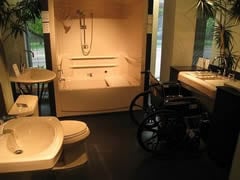
A safer aging-in-place bathroom might include:
- A curbless or low-threshold shower
- Properly installed grab bars or structural blocking for future grab bars
- Slip-resistant flooring
- A handheld showerhead
- A shower seat or bench
- An accessible-height toilet
- Easy-to-operate faucets
- Improved lighting
- Adequate maneuvering space
The objective should be more than preventing falls. A well-designed bathroom can help someone continue using the bathroom independently and with dignity.
Make the Kitchen Easier to Use
Kitchen safety involves accessibility as much as accident prevention.
Frequently used items should be easy to reach without climbing on stools or repeatedly bending down. Pull-out shelving, drawers instead of deep lower cabinets, improved task lighting, lever-style faucets, accessible work surfaces, and easy-to-use appliances can make everyday activities easier.
Whenever possible, the kitchen should provide enough open space for someone using a walker or wheelchair in the future.
Create a Safe Entrance
A home cannot truly support aging in place if getting through the front door becomes difficult.
Consider the entire route from the driveway or sidewalk to the entrance. Look for uneven pavement, steps without handrails, poor lighting, slippery surfaces, and difficult-to-operate door hardware.
Depending on the home, long-term improvements could include a zero-step entrance, a gently sloped walkway or ramp, a wider doorway, lever-style hardware, improved exterior lighting, or a covered entry.
Even when these features are not immediately necessary, planning for them can make future modifications much easier.
Look at Doorways, Hallways and Flooring
Aging-in-place planning should consider how easily someone could move through the house if they eventually needed a cane, walker, or wheelchair.
Doorways and hallways should provide adequate clearance, while flooring should remain as smooth and consistent as possible between rooms.
Thresholds, abrupt flooring transitions, narrow doors, and tight turns that seem insignificant today can become major obstacles later.
Consider the Bedroom
The bedroom should provide a safe route between the bed, bathroom, closet, and doorway.
There should be enough space around the bed for safe movement and, ideally, enough flexibility to accommodate future mobility equipment or caregiver assistance.
Convenient lighting controls, accessible electrical outlets, reachable storage, and nighttime pathway lighting can also improve safety.
Whenever practical, having a bedroom and full bathroom on the main level can greatly expand a home's ability to accommodate changing needs.
Add Smart Home Technology
Technology is becoming an increasingly important part of aging in place.
Depending on the homeowner's needs, a safer home might eventually incorporate smart locks, video doorbells, voice-controlled lighting, smart thermostats, automatic lighting, water-leak detection, medication reminders, fall-detection systems, emergency-response technology, and remote monitoring.
Technology should not replace good physical design. Instead, it should become another layer of protection that supports safety, independence, communication, and peace of mind.
Think Beyond Today's Needs
One of the biggest mistakes homeowners make is waiting for a medical emergency or mobility problem before modifying the home.
Aging in place works best when it is planned.
Someone who easily climbs stairs today may find them difficult following surgery or illness. A traditional bathtub may work today but become a barrier later. A narrow bathroom doorway may never seem important until a walker is needed.
That is why aging-in-place planning should consider three questions:
Is the home safe today?
Could it accommodate changing physical abilities tomorrow?
Could someone continue living here if they suddenly needed mobility assistance or temporary caregiving?
A Safer Home Is a More Adaptable Home
Making a home safer does not mean predicting every possible health problem. It means creating an adaptable or flexible environment as life changes.
Some homeowners may only need better lighting, grab bars, and improved flooring. Others may benefit from a comprehensive plan involving an accessible bathroom, kitchen modifications, wider doorways, a zero-step entrance, smart technology, or first-floor living.
The important thing is to develop a plan before those improvements become urgent. This is what is known as a forever home blueprint.
At T-Square Company, aging in place is about more than remodeling a house. It is about creating a home that continues to support the people living there safely, comfortably, and independently for as long as possible, using your forever home blueprint as a guide.
David Traut, CAPS, the owner of T-Square Company in Austin, Texas, is the award-winning author of Age in Place at Home: Adapting the Home Environment for All Generations, available on Amazon. His book offers great ideas and information for creating your forever home blueprint for aging in place.
A safer home today can become the foundation for a more independent tomorrow.
