The Basic Problem
If stairs are becoming harder to navigate, you don't necessarily have to leave the home you love. A stairlift may be the solution that allows you to keep living safely, comfortably, and independently in your Austin-area home.
One of the first questions homeowners ask is:
How much does a stairlift cost?
The answer depends on several factors, including the type of staircase, the length and configuration of the stairs, the lift you need, safety and comfort features, installation requirements, and whether your home needs additional modifications.
As a general 2026 planning range, professionally installed stairlifts can typically cost approximately $2,300 to $24,000, with more complex curved or custom installations potentially exceeding that range. Straight stairlifts are generally less expensive because they use a standardized rail, while curved stairlifts require a rail designed specifically for the staircase.
At T-Square Company in Austin, we believe the better question isn't simply, "What does a stairlift cost?"
It's:
"What will it take to keep my home working for me?"
That's the heart of aging in place.
What Is a Stairlift?
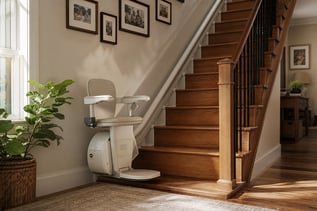
A stairlift is a motorized chair that travels along a rail installed alongside a staircase.
The user sits in the chair, secures the safety belt, and operates the lift using a control. The lift carries the person between floors without requiring them to climb the stairs.
Modern stairlifts can include features such as:
- Swivel seats
- Retractable seat belts
- Fold-up seats and armrests
- Safety sensors
- Battery backup
- Remote controls
- Powered footrests
- Different seat configurations
- Perch or standing-position options
The purpose isn't to make someone feel "old."
It's to remove a barrier between you and the rooms you want to continue using.
How Much Does a Stairlift Cost in Austin?
National 2026 pricing data provides a useful starting point, but your Austin-area project can vary substantially depending on your staircase and installation requirements. Current published ranges include approximately:
| Stairlift Type | Typical 2026 Planning Range |
|---|---|
| Straight stairlift | $2,000–$9,000 |
| Curved stairlift | $10,000–$25,000+ |
| Platform lift | $5,000–$20,000 |
| Outdoor stairlift | $4,000–$25,000 |
| Used stairlift | $1,500–$3,000 |
These figures are general planning ranges, not T-Square quotes. Actual project costs depend on the equipment selected, staircase configuration, installation, electrical requirements, modifications, and other site-specific conditions.
For many homeowners, a straight stairlift will be the most economical option.
But if your stairs turn, curve, have an intermediate landing, or serve multiple levels, a custom curved system may be necessary.
Straight vs. Curved Stairlifts
One of the biggest factors affecting stairlift cost is the shape of your staircase.
Straight Stairlifts
A straight stairlift is designed for a staircase that travels in one continuous direction without curves or intermediate turns.
Because the rail is relatively straightforward, these systems are generally the least expensive type of permanent stairlift.
Current 2026 cost data places straight stairlifts at approximately $2,000–$9,000, depending on the model, features, installation, and staircase.
A straight lift may be appropriate when:
- The staircase is completely straight
- There is adequate space at the top and bottom
- The user can safely transfer into and out of the seat
- The staircase configuration doesn't require a custom rail
For many Austin homeowners, this is the simplest and most cost-effective solution.
Curved Stairlifts
Curved staircases are more complicated.
If your stairs include a turn, bend, spiral section, or intermediate landing, the rail generally needs to be custom-designed for your home.
That's why curved stairlifts can cost significantly more.
Current estimates commonly place curved systems around $10,000–$25,000 or more, depending on the number of turns, length, customization, features, and installation requirements.
The cost can increase with:
- Multiple turns
- Long staircases
- Multiple floors
- Tight landings
- Custom rail fabrication
- Specialized seating
- Difficult installation access
A curved stairlift can still be an excellent investment when the alternative is giving up access to an entire level of your home.
What Factors Determine Stairlift Cost?
1. The Shape of Your Staircase
This is usually the first thing we evaluate.
Is the staircase:
- Straight?
- L-shaped?
- U-shaped?
- Curved?
- Split-level?
- Multi-story?
A simple straight staircase usually requires less customization than a staircase with multiple turns.
2. The Length of the Staircase
The longer the staircase, the more rail and installation work may be required.
A short staircase between two floors may be relatively straightforward.
A long staircase with multiple landings can require substantially more equipment and customization.
For curved staircases, the number of steps and turns can have a particularly significant effect on price. Current cost data shows curved systems increasing substantially as staircase length and complexity increase.
3. The Person Using the Stairlift
The best stairlift isn't necessarily the one with the lowest price.
It needs to match the person.
Consider:
- Can the person sit and stand safely?
- Do they have difficulty bending their knees?
- Do they need additional support?
- Can they transfer from a wheelchair or walker?
- Is a swivel seat appropriate?
- Would a perch-style lift be easier?
- What is the person's weight?
- Do they have sufficient upper-body strength?
- Will a caregiver need to accompany them?
This is where an aging-in-place assessment can be particularly valuable.
A stairlift is a piece of equipment.
Aging in place is a design strategy.
4. Seat and Comfort Features
Basic stairlifts can be very functional, but additional features can improve comfort and safety.
Options may include:
Swivel Seat
A swivel seat can make getting on and off the lift easier by allowing the user to turn toward the landing rather than stepping directly off the stairs.
Powered Swivel Seat
A powered swivel mechanism can be helpful when a person has limited strength or mobility.
Perch Seat
A perch-style configuration allows the user to travel in a more upright position and may be appropriate for some people who have difficulty bending their knees.
Powered Footrest
A powered footrest can make it easier to fold or position the footrest without reaching down.
Safety Belt
A secure, easy-to-use restraint is an important part of safe operation.
Obstruction Sensors
Sensors can stop the lift if an object is detected in its path.
Battery Backup
Many stairlifts use battery power, allowing the lift to continue operating during a power outage.
Current cost guides identify these types of features as potential additions to the project price.
5. Electrical Requirements
Many modern stairlifts are battery-operated and charge through charging points along the rail or at designated locations.
Depending on the installation, electrical work may be necessary.
Your installer should evaluate:
- Existing outlets
- Power availability
- Charging location
- Electrical requirements
- Battery backup
- Code requirements
This should be evaluated before installation rather than discovered halfway through the project.
6. Staircase Width
The staircase needs to accommodate both the stairlift and the person's safe movement.
This is especially important in homes where another family member may still need to walk up and down the stairs.
A stairlift should not be viewed as an isolated piece of equipment.
The staircase remains part of the home's circulation system.
The installation should consider:
- Remaining walking clearance
- Handrail location
- Seat width
- Footrest position
- Doorways near the staircase
- Top and bottom landing space
7. The Top and Bottom Landings
Where will the user get on?
Where will they get off?
This sounds simple, but landing space can make a significant difference in usability.
At the top of the stairs, the user needs enough space to safely turn and transition into the next room.
At the bottom, there needs to be adequate space to exit the lift without creating a new hazard.
In some homes, the landing itself may need modification.
8. Existing Handrails
A stairlift may occupy some of the space where an existing handrail is located.
That doesn't mean the handrail should simply be removed.
For many aging adults, a handrail remains an important safety feature.
The goal is to determine how the stairlift and handrail can work together—or whether another solution is needed.
This is one example of why a professional assessment is preferable to simply ordering a stairlift online.
9. Structural and Installation Conditions
Stairlifts are typically anchored to the stair treads or appropriate structural surfaces.
The installer needs to evaluate the existing staircase and determine how the rail will be securely installed.
Older homes, unusual stair construction, narrow stairs, and difficult access can create additional installation considerations.
The equipment must be properly anchored, aligned, and tested.
Does Installing a Stairlift Damage Your Stairs?
In many installations, the stairlift rail is mounted to the stair treads rather than requiring major structural changes to the staircase.
However, every home is different.
If you eventually remove the stairlift, there may be mounting holes or other minor repairs to address.
The extent of restoration depends on the installation and the condition of the stairs.
This is another reason to discuss both the immediate and long-term plans before choosing equipment.
Stairlift vs. Moving: Which Costs More?
This is an important question for aging-in-place homeowners.
If stairs become difficult, families sometimes assume that moving to a one-story home is the only solution.
But moving has costs that aren't reflected in the price of a stairlift:
- Real estate commissions
- Moving expenses
- Repairs to prepare the current home for sale
- Purchasing a new home
- Higher or different property taxes
- Changes in the neighborhood
- Loss of familiar surroundings
- Emotional cost
- Loss of community connections
A stairlift may allow you to continue using the home you've already invested in.
T-Square's Austin-area aging-in-place work focuses on helping homeowners evaluate modifications before assuming that moving is necessary. T-Square's current accessibility guidance specifically identifies stairlifts as one of the major modifications that can help homeowners continue living in multi-level homes.
Is a Stairlift Right for You?
A stairlift can be an excellent solution when the primary problem is getting safely between floors.
But it isn't the right answer for every homeowner.
For example, someone who uses a wheelchair may not be able to transfer safely from the wheelchair to a stairlift seat.
In that situation, other solutions may need to be considered.
Depending on your home and needs, alternatives can include:
First-Floor Living
Sometimes, the most practical solution is to reorganize the home so that essential daily activities happen on one level.
Vertical Platform Lift
A vertical platform lift can carry a wheelchair or mobility device between levels and may be more appropriate when transferring into a stairlift isn't practical.
Residential Elevator
For homeowners planning significant long-term accessibility, an elevator may provide a comprehensive solution between multiple floors.
Home Remodeling
A first-floor bedroom, accessible bathroom, or relocated laundry area can sometimes reduce the need to use stairs altogether.
Relocating
Moving is always an option—but it doesn't have to be the first option.
Stairlift or Wheelchair Lift: What's the Difference?
The simplest distinction is:
A stairlift carries a person.
A platform lift carries a person and their mobility device.
If you can safely transfer into a chair, a stairlift may be a practical and relatively economical solution.
If you need to remain in your wheelchair, a platform lift or another accessibility solution may be more appropriate.
This distinction is extremely important when planning an aging-in-place modification.
When Should You Install a Stairlift?
Many homeowners wait until they can no longer safely use the stairs.
We recommend thinking about the problem earlier.
You don't necessarily have to install a stairlift the moment you notice that stairs are becoming more difficult.
But you can begin planning.
Ask yourself:
"What happens if stairs become impossible for me six months from now?"
Planning before a crisis gives you time to:
- Evaluate your options
- Compare costs
- Modify the home gradually
- Consider first-floor alternatives
- Prepare financially
- Select the right equipment
- Avoid rushed decisions
T-Square recommends a proactive approach to aging in place because planning before a major mobility change gives homeowners more choices.
What About Stairlift Maintenance?
Like any mechanical equipment, stairlifts require attention over time.
Regular maintenance can help identify:
- Battery issues
- Worn components
- Track problems
- Seat or belt issues
- Sensor problems
- Unusual noises
- Charging problems
A manufacturer's recommended service schedule should be followed.
For curved stairlifts in particular, professional service can be important because the equipment is customized to the staircase.
Should You Buy or Rent a Stairlift?
Buying isn't always the only option.
Some homeowners consider renting when:
- The need is temporary
- Recovery from surgery is expected
- The homeowner isn't sure how long the equipment will be needed
- A family member needs temporary assistance
Buying may make more sense when:
- You're planning to age in place
- The need is expected to be long-term
- You want specific features
- You want the equipment configured specifically for your staircase
Your circumstances and the type of staircase should guide this decision.
Can You Buy a Used Stairlift?
Used stairlifts can cost less than new systems. Current 2026 estimates put used stairlift pricing around $1,500–$3,000, although compatibility with your staircase and the condition of the equipment are critical considerations.
The challenge is that not every stairlift can simply be transferred from one home to another.
Straight systems may be easier to reuse than curved systems because curved rails are typically custom-made for a particular staircase.
Before purchasing used equipment, consider:
- Is it compatible with your staircase?
- Is replacement equipment available?
- Is the battery in good condition?
- Is the warranty transferable?
- Who will install it?
- Who will service it?
- Are safety features functioning correctly?
Saving money on the equipment isn't worthwhile if you end up with an unreliable or poorly supported installation.
Does a Stairlift Require a Permit in Austin?
Permit requirements depend on the specific scope of work and the location.
The City of Austin recommends using its residential permitting guidance to determine whether a particular construction project requires a permit. Projects involving additional electrical or structural work may have different requirements.
A qualified professional should evaluate the project rather than assuming that every stairlift installation is either automatically permitted or automatically exempt.
Why a Home Assessment Matters
You can measure your staircase yourself.
But measurements don't tell the whole story.
An aging-in-place assessment looks at the person, the home, and the way the home is used.
At T-Square Company, our approach considers physical and emotional needs as part of the accessibility planning process. Our CAPS-certified approach is designed to help homeowners identify modifications that support safety, independence, and long-term livability.
We may ask:
- Which rooms do you use every day?
- Which stairs are becoming difficult?
- Do you use a cane, walker, wheelchair, or other mobility device?
- Can you safely transfer into a chair?
- Do you have balance concerns?
- Do you live alone?
- Will a caregiver need to assist you?
- What are your plans for the next 5–10 years?
- Would first-floor living make sense?
- Are there other areas of the home that should be addressed at the same time?
The answers help determine whether a stairlift is the right solution—or whether another modification would serve you better.
The Real Value of a Stairlift
The value of a stairlift isn't just measured in dollars.
Imagine being able to:
- Continue sleeping in your upstairs bedroom
- Use the bathroom on both floors
- Visit your home office
- Access your grandchildren's rooms
- Enjoy your second-floor living spaces
- Avoid giving up part of your home
- Remain in the neighborhood you love
For many homeowners, that's the real return on investment.
Independence has value.
Safety has value.
Staying in the home you love has value.
Planning for Your Forever Home
A stairlift can solve a very specific problem: stairs.
But successful aging in place looks at the entire home.
The staircase may be the first obstacle you notice, but there may be other opportunities to make your home safer and easier to use.
Depending on your needs, an aging-in-place plan may include:
- Better stair lighting
- Improved handrails
- Non-slip flooring
- Curbless showers
- Grab bars
- Wider doorways
- Lever-style hardware
- Accessible kitchens
- Pull-out storage
- Improved bathroom layouts
- Wheelchair ramps
- Vertical platform lifts
- First-floor bedroom suites
- Smart-home technology
T-Square's current Austin accessibility work emphasizes creating homes that can adapt as residents' needs change rather than simply installing isolated accessibility products.
That's the difference between adding a stairlift and planning a home for aging in place.
How Much Should You Budget for a Stairlift?
As a general 2026 planning guide:
Straight stairlift: approximately $2,000–$9,000
Curved stairlift: approximately $10,000–$25,000+
Platform lift: approximately $5,000–$20,000
Outdoor stairlift: approximately $4,000–$25,000
These figures are broad national planning ranges. Your Austin-area project may be higher or lower depending on the equipment, staircase, installation, features, electrical work, and other modifications.
The best way to get an accurate number is to have the home and staircase evaluated before selecting equipment.
Don't Let the Stairs Decide When You Have to Move
Your home is more than a building.
It's where you've built your life.
It's where your memories live, where your community may be, and where you may want to remain for many years to come.
If stairs are becoming difficult, don't automatically assume that it's time to move.
A stairlift may be one piece of a larger plan that allows you to remain safely and comfortably in the home you love.
At T-Square Company, we help Austin and Central Texas homeowners look at accessibility differently.
We're not just asking:
"What product should we install?"
We're asking:
"How can we make this home work for you for the years ahead?"
Ready to Make Your Home Your Forever Home?
T-Square Company is an Austin-based remodeling and accessibility company specializing in Aging in Place, Universal Design, and home modifications.
David L. Traut, CAPS, President of T-Square Company, has more than 30 years of experience helping Central Texas homeowners create homes that support safety, independence, comfort, and long-term livability.
If you're considering a stairlift—or you're beginning to think about how your home can adapt as your needs change—start with an Aging-in-Place Home Assessment.
Call T-Square Company at 512-444-0097 to schedule a professional home assessment.
Your stairs don't have to determine your future.
Let's create a home that works for you—today, tomorrow, and for years to come.
About T-Square Company
T-Square Company is an Austin, Texas, remodeling and design/build company specializing in Aging in Place, Universal Design, accessibility remodeling, and home modifications.
Led by David L. Traut, CAPS, T-Square helps homeowners throughout Austin and Central Texas create safer, more comfortable, and more accessible homes that support independence through every stage of life. David is the award-winning author of Age in Place at Home: Adapting the Home Environment for All Generations, available on Amazon. He is a founding member of the National Aging in Place Council (NAIPC).
T-Square Company
Austin, Texas
512-444-0097
Cost information in this article is provided for general planning purposes and is not a project-specific estimate. Actual stairlift costs vary based on equipment, staircase configuration, installation requirements, features, site conditions, and other project-specific factors.